
about the work
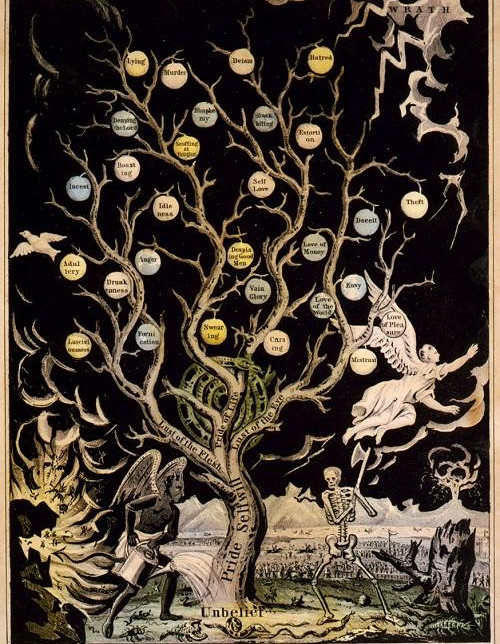
The title Tree of Death most obviously references the Bible’s Matthew 7:17, “But a corrupt tree bringeth forth evil fruit”, wherein the human soul is likened to a fruit-bearing tree. The quality of a soul’s fruit is said to be reliant upon the forces nurturing it. In Tree of Death, the human soul, represented according to this tree metaphor, is tended by a demon, a representative of vice and evil impulses, and thus “bringeth forth evil fruit.”
The demon in question waters ground labeled “unbelief”, out of which the eponymous Tree of Death grows. Its trunk, branches, and fruits are inscribed with different manifestations of immorality – “lying”, “idleness”, “swearing”, etc. A skeleton, the personification of death, stands poised to chop down the tree. In place of the sun, a dark thundercloud labeled “wrath” obscures the entire sky, and all manner of scorpions, insects, snakes, etc. – representatives of evil and filth – crawl along the ground. In the background a great number of people are gathered for what may be the Last Judgement, and behind the demon watering the tree a fiery portal to the underworld belches smoke and fire.
In the 19th century United States, such works codified an emerging national identity. 19th century America was still a young and fractious nation. Americans of the time wouldn’t have described themselves as “American” but rather as Virginian, South Carolinian, Ohioan, Dutch, Pawnee, Sioux, British, or French, etc. Printed media like Currier & Ives’ The Tree of Death spread a sense of common values and distinctly American cultural narrative between these divided groups, paving the way for the young nation’s emerging national identity.
about the artist
New York-based Nathaniel Currier and James Ives were the 19th century’s most successful and well-known American lithographers, producing over 7,000 editions between 1834 and 1907.
“The success of Currier & Ives was part of the larger story of widespread American upward mobility and the mechanization of publishing. From Andrew Jackson’s 1828 presidential inauguration through the Civil War, Americans experienced astonishing growth in material comfort, leisure time, and literacy. At the same time, technological innovations cut costs and increased the output of printed words and pictures. Newspapers and magazines, many illustrated with wood engravings, reached thousands of Americans.” (LIMAHC)
Artifacts of this time are as much historical records as art objects – they document the cultural and social mores of Victorian-era America’s rising middle class. In some cases, the tastes of this historic social class have persisted into or influenced tastes within the present day; contemporary Americans avidly consume television and newspaper reports on floods, fires, and transportation accidents as avidly as Currier & Ives’ customers consumed prints depicting them. In other cases, as in The Tree of Death, popular taste has shifted greatly; what was once seen as appropriate decoration for well-appointed homes appears macabre to contemporary viewers.