
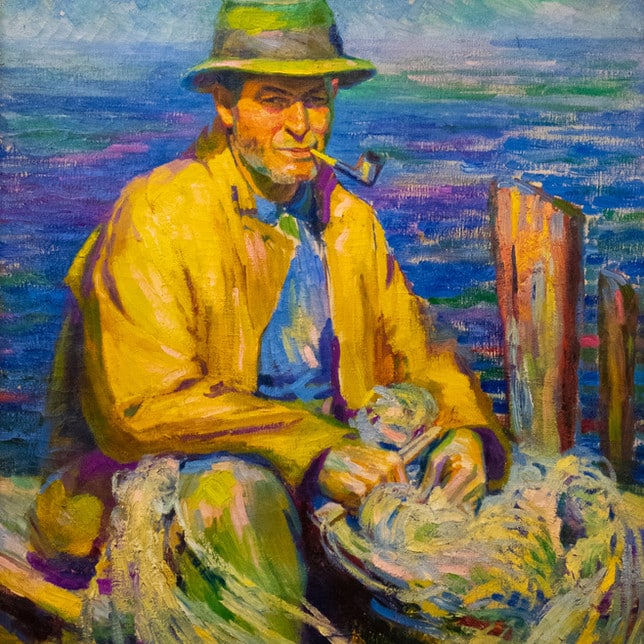
about the work
According to correspondence from B. King Couper, Josephine Sibley Couper’s son, the subject of this painting operated a tourist boat concession at the Rocky Neck Artist’s Colony in Gloucester, Massachusetts. Reputed to have been a Civil War veteran, he would have been 70 – 80 years old at the time he sat for the painting in 1925.
about the artist
Josephine Sibley Couper was born in 1867, two years after the end of the American Civil War; to Josiah and Emma Sibley, a fabulously wealthy pair who owned “cotton factorage, textile manufacturers, mercantile establishments, shipping, banks, railroads, and real estate”. Sympathetic twentieth-century biographers ascribed a number of dubious and seemingly contradictory qualities to Couper’s father – among them, that he refinanced southern banks after the collapse of C.S.A. issued currency, yet was a “staunch Southern partisan who actively and financially supported the South’s cause” yet was also “an early abolitionist who freed his slaves, educated and trained them for trades and financed the start of their own businesses”. According to the same sources, this mythic figure inhabited an equally mythic home – a sprawling brick mansion that occupied an entire city block of downtown Augusta with “residences, stables, and gardens.” At the age of 76, Couper still described herself as “in awe” of the opulence of her childhood home and wealth of her father.
As with many historical accounts of the Southern gentry during and immediately after the Civil War, the details of Couper’s early life are sketchy at best. However, we do know that at age 12 she embarked, with her family, on the “European Tour” that was customary for well-heeled Americans in the 19th century. They traveled through Ireland, Scotland, Wales, England, Belgium, Germany, Switzerland, and France, taking in parks, theatres, cathedrals, palaces, museums, and landmarks of all kinds. Couper’s first demonstrated interest in the visual arts began on this tour, where she kept a hand-drawn diary of all the art and architecture she saw. It is interesting to note the family’s vacation took them through Paris in 1879, only four years after a controversial new style of painting had been named “impressionism” by French critic Louis Leroy, after the works of upstart artist Claude Monet, which Leroy saw as unfinished sketches or “impressions”.
After her family’s return from Europe, Couper impressed her father with the many sketches she had made of the journey. He engaged a private tutor for her and from then until her marriage at age 24, she studied intensively at home and abroad, developing her nascent talent into real skill as a draftsman and painter. After her marriage, the subjects of Couper’s works became domestic rather than academic. She painted portraits of her husband, children, and friends, and views of the landscapes surrounding her home and garden. In 1900 the family moved to Spartanburg, where Couper founded the Spartanburg Arts and Crafts Club with friend and fellow artist Margaret Law. In 1907 this organization brought the then highly-acclaimed Robert Henri to Spartanburg and solicited donations of 10, 15, and 20 cents “on the streets”, in Couper’s words, to purchase the artist’s The Girl With Red Hair, which remains in Spartanburg today in the permanent collection of Spartanburg Art Museum.
After the death of Couper’s husband in 1913, she resumed her travels and study of painting in international ateliers, eventually settling in Tryon, NC in 1934, where she remained, painting, until her death in 1957. Until the last, Couper was a striking sight on the streets of Tryon, where residents recalled her anachronistic “erect figure, great dignity, flashing azure blue eyes, complete with white gloves and gold-headed walking cane. ‘Stand straight,’ she would frequently admonish the young folk around her, emphasized with a brisk tap of her walking cane…[she was] the epitome of a southern lady.”